Race Spotlight: The Valefolk
Pull up a stool. Second race in the series, and this one's the folk you'll actually meet first — because every road in the Vale crosses their river, and every crossing costs a penny.
The Valefolk are the valley's humans. Millers, ferryfolk, toll-keepers, orchard farmers, and the wardens of the one good bridge. They've been here longer than anybody's records, including their own, and they will tell you so — usually while charging you to cross it.
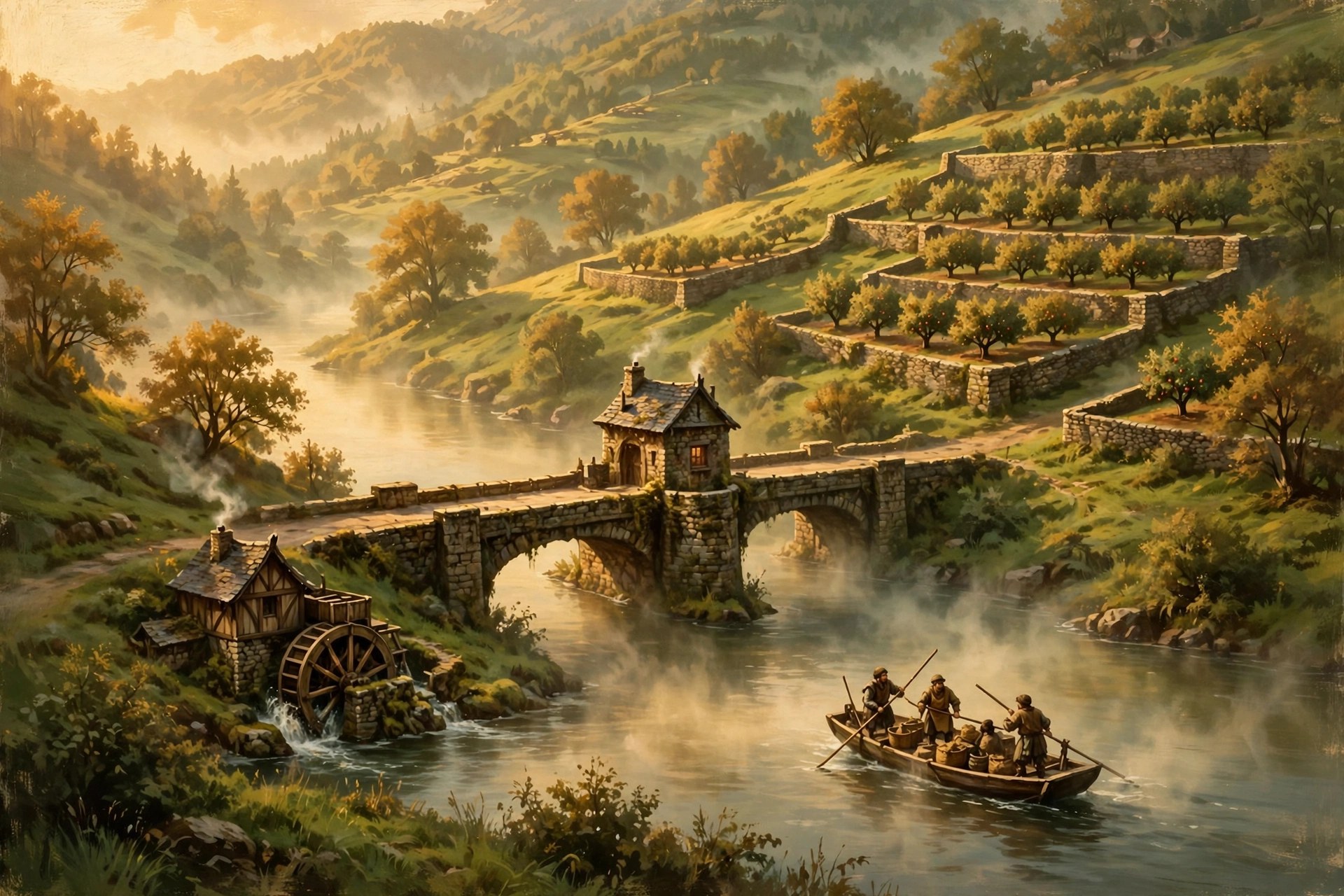
The Long Bridge at first light — the toll-house sits at its center, and the Book sits inside that.
They're not a kingdom and they've got no king. What they've got is a river, a road, a millpond, and strong opinions about tolls. Elves, dwarves, and the other ancient peoples are all very well in their place, the Valefolk say — and their place is not the valley floor. The valley floor belongs to whoever can hold a plow, a pole, or a toll-book steady. That'd be them.
Who they are
Picture them plain: sturdy, weather-browned, five and a half to six feet tall, forearms like fence posts from poling ferries and swinging scythes. Hair brown, black, or sandy. Faces plain, and they stay that way — a Valefolk dressed fine is assumed by other Valefolk to be up to something. Wool, leather aprons, good boots. Their wealth is in tools, livestock, and the state of their fences.
They're plain-spoken to the edge of rudeness, generous at their own tables and exact at everybody else's. And they keep a toll-keeper's faith: every crossing is recorded, every debt is remembered, and every bargain, once struck, is struck forever. Which cuts both ways, and they'll be the first to tell you so, at length, if you try to wriggle out of one.
A Valefolk lives about seventy-five years, works most of them, and considers a person who's never been rained on for a living to be, in some way they can't quite name, unfinished.
The Toll and the Book
The valley runs on crossings, and crossings run on the Toll Book — a great ledger kept at the Long Bridge, in a hand that hasn't changed in living memory, because the toll-keepers teach it to their children letter by letter. To be “in the Book” is to be a person of standing. To be struck out of it is the worst punishment the valley knows. Worse than a fine, because a fine ends.
Three trades hold the valley together. The millers grind everybody's grain and know everybody's business to the bushel. The ferryfolk move what the bridge can't, and bury what the river gives back, and do not talk about the second duty. The bridge wardens keep the road, the toll, and the peace — in that order — and elect their captain at every harvest from among the toll-paying households.
An adventuring Valefolk is usually a younger child with more strength than inheritance, a warden between elections, or somebody whose name is in the Book in the wrong column. The valley produces all three in reliable numbers.
Where they fit in the Vale
Where the Duskbough keep their hollow and the hill peoples keep their heights, the Valefolk keep the open valley floor: flat, green, fenced, and thoroughly owned. Five places worth knowing:
- Hale's Ford and the Mill — the great water mill, held by the Hale family since before the Toll Book. The master miller is deep in a slow, secret negotiation about a new road.
- The Long Bridge — stone older than the Toll Book, toll-house at its center, the Book chained to a desk that has outlasted four toll-houses.
- The Ferry — flat-bottomed, worked day and night. The ferryfolk answer the bell for coin, for kin, or for a body, and ask no questions about any of the three.
- The Orchard Terraces — hillside orchards famous for cider, wasps, and boundary stones that move at night. The Valefolk blame the neighbors. The neighbors blame the stones.
- The Drowned Chapel — a chapel of some old faith standing in the marsh where the river moved a century ago. The bell still rings, sometimes, under the water. The ferryfolk row wide around it after dark.
And what do they fear? Flood, above all. A bad freshet can take the mill, the bridge, and the year's grain in one night. Every Valefolk family keeps a mark cut in a doorpost showing where the worst water reached — and how close it came to the children's beds.
How they play
Valefolk are a human variant in standard Basic Fantasy format. Any single class, same as other humans — but no combination classes. Hardy stock is the valley's one vanity: minimum Constitution 9, no other ability requirements or limits.
Like all humans, they learn fast: +10% to all experience points earned. Generations of bad water, mill dust, snakebite, and river fever left their mark: +2 on saves vs. Poison. And Rivercraft — every Valefolk can swim at half their normal movement rate in calm water, and one raised on the ferry or the millpond can handle a boat, a raft, or a pole barge without any roll in ordinary conditions. They start knowing Common, full of river words — freshet, backwater, deadfall, toll — and other valley folk can place a Valefolk within a mile of home by how he pronounces “ford.”
Names to steal: Tobin, Brisa, Pell, Marla, Osric, Fenna, Dain, Sella, Corin, Willa. Family names: Hale, Cole, Orchardson, Senn, Marlow, Fenn, Tolliver, Bridges. (Sella and Corin are Duskbough names too — the valley shares more than it admits.)
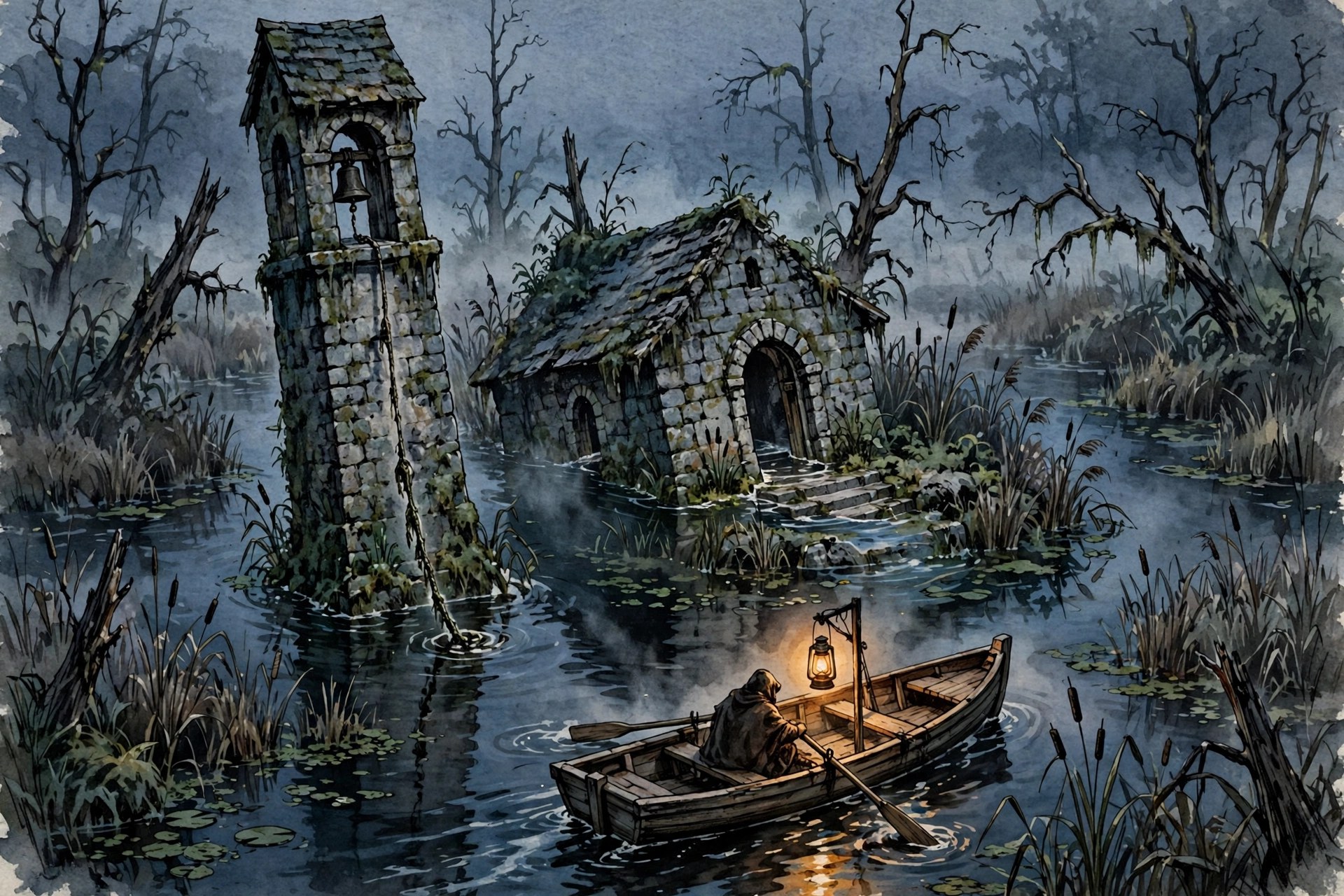
The Drowned Chapel — the bell still rings, sometimes, under the water.
A GM note
The Valefolk are the easiest race in the book to run, and the easiest to underestimate. They look like the plain option. They're not. A plain option with a ledger is a plot engine.
The Book is a loaded crossbow pointed at your campaign. Somebody steals it — or worse, changes a page. Somebody starts leaving the toll unpaid, in exact change, at the bridge, every night. A name appears in the Book that nobody wrote: a whole family, crossings paid a hundred years in advance, in a hand that matches the current toll-keeper's perfectly. The Widow Senn, who has kept the Book for thirty years and can spot a liar at forty paces in fog, will pay for quiet investigators — and pay double if the answer is boring.
And don't forget what's under the water. A giant pike as long as a ferry pole lurks under the crossing, old enough to have opinions about boats. Under the Long Bridge lives a mudcat the size of a hog that swallows small creatures whole — the toll-keepers feed it table scraps and call this an arrangement.
So: a player who picks Valefolk isn't picking the boring human. They're picking the person who knows everybody's debts, everybody's crossings, and where the bodies went in. Hand them the tally stick and watch what they do with it.
Get the book
The Valefolk — the complete playable race for Basic Fantasy RPG, with the full write-up, the valley-floor gazetteer, two persons of the valley (Master Miller Tobin Hale and Widow Senn, Toll-Keeper of the Long Bridge), two new creatures (Giant Pike and Mudcat), six adventure hooks, and two ready-to-play 1st-level Valefolk characters — is free / pay-what-you-want (suggested $1.00) on itch.io: https://artificial-ryan.itch.io/the-valefolk
It pairs with last week's spotlight, The Duskbough Elves — the miller's road runs both ways.
Next week: the Emberdeep Dwarves. Bring a torch. The forges are down deep, and the ancestors are listening.
— Walt