Race Spotlight: The Cragtop Dwarves
Pull up a stool, and mind the wind — fourth race in the series, and this one takes us up instead of down. The Emberdeep keep the mountain's insides. The Cragtop keep the roof. Ask a dwarf of the Cragtop what the mountain is, and he will point up, not down. The mountain is the roof of the world, and his family has kept it swept for six hundred years.
They are the valley's hill dwarves — the high path of their people. Where their Emberdeep kin delved into the ridge and stayed, the Cragtop settled its back: round stone villages along the spine of the heights, goat herds on the scree, weather-wardens reading the sky, and great ridge-eagles in the aeries above the roofs, tallied as citizens and addressed, on formal occasions, as the senior branch of the family. They are not deep folk who came up for air. They are sky folk who happen to be dwarves, and they regard a roof of stone overhead the way their cousins regard a roof of weather: as a failure of planning.
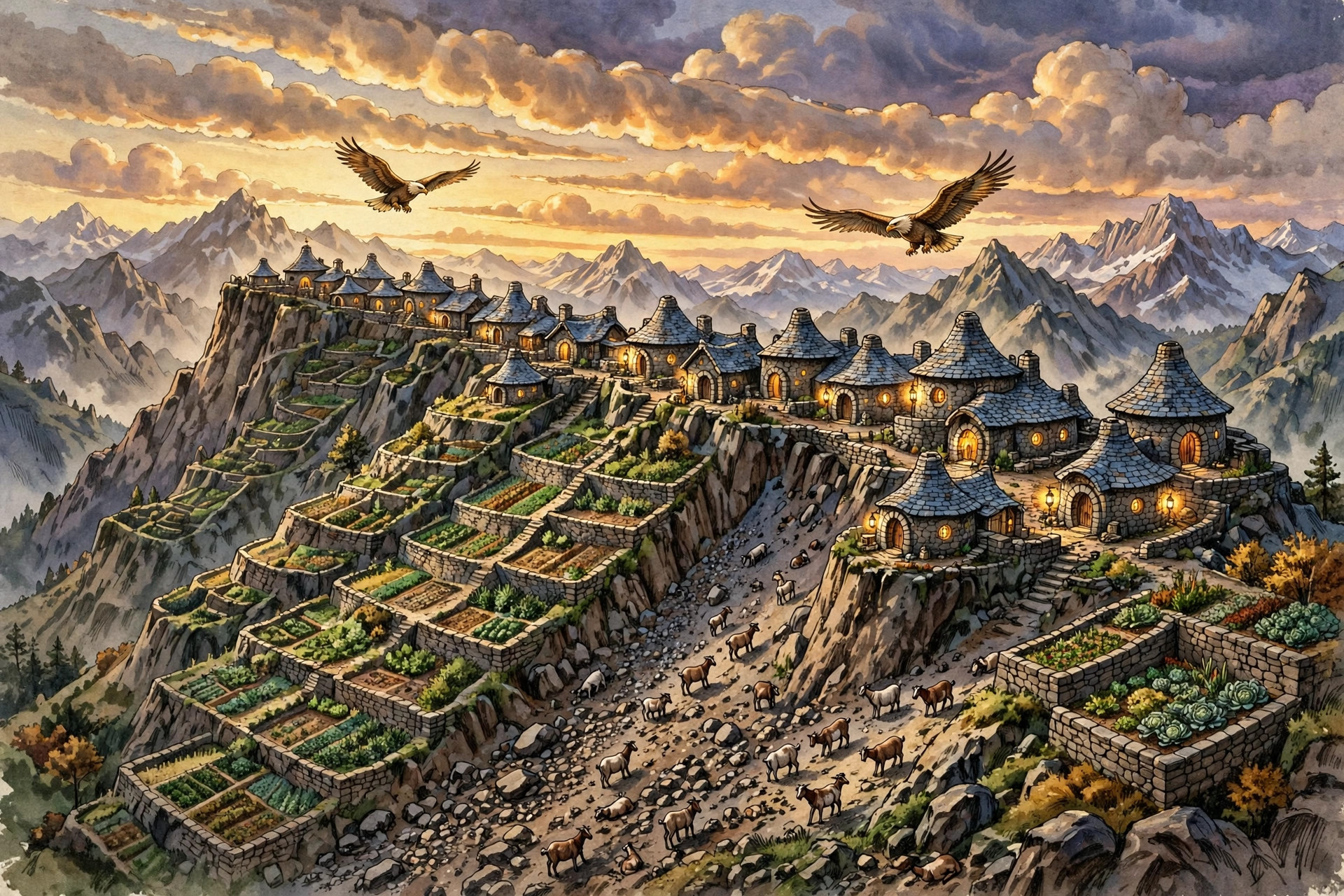
The ridge villages at dusk — round stone, slate roofs, goat-smell, and eagles overhead. Six hundred years of keeping the roof swept.
Who they are
Picture them short, wiry, and weather-burnt: around four feet tall, a hundred and ten pounds, built leaner than their deep cousins by wind, slope, and goat-work. Hair and beards — worn long, unbraided or in a single tail to keep them out of the wind — run brown, red-brown, and grey, bleached at the ends by sun and weather. Their skin is fair under a permanent hill tan, and their eyes are famously far-sighted: a Cragtop can name the goats on the far ridge, and will, whether or not you asked.
They are cheerful by dwarf standards — which is to say, blunt, loud at their own tables, and given to settling arguments by pointing at the weather and being right about it. They keep their promises, their grudges, and their herds with equal care, and they consider a person who has never been properly rained on to have been cheated by their upbringing. A Cragtop typically lives three to four centuries, most of it outdoors, and regards the Emberdeep habit of living inside the mountain the way you might regard a cousin who has taken to living in a very fine cellar.
The Weather Reckoning and the Aeries
Every Cragtop village keeps a Weather-Keeper, who reads the sky at dusk, sets the next day's work by it, and records the weather of every day in the village ledger — six hundred years of weather, unbroken, in a hand taught child to child. The ledgers are the Cragtop's true treasure: a farmer, a sailor, or a general who could read them all would know things about the valley's sky that nobody alive remembers learning. The Weather-Keepers lend readings. They do not lend ledgers.
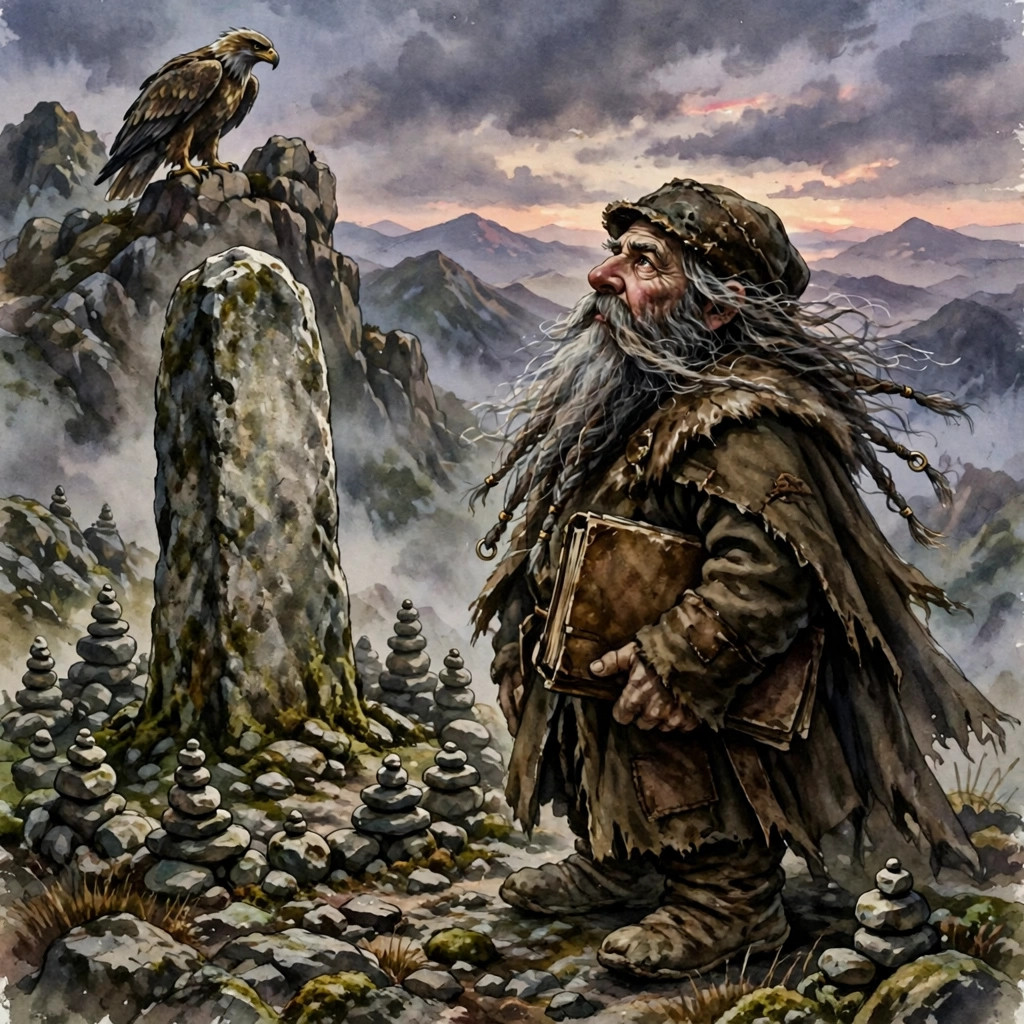
The Weather Stone at the ridge's crown — where the Keepers read the dusk sky, ringed by six hundred years of small, careful cairns.
Above each village, in the highest crags, the ridge-eagles nest, and the eagle-wardens tend them — feeding, doctoring, carrying messages, and speaking for the birds in village councils, where the aerie holds a seat and, on paper, a vote. The eagles are not tame and are not mounts; a warden who flies does so because an eagle has decided to allow it, and the wardens are careful to keep the arrangement on that footing. A young Cragtop's first adult duty is a season in the aerie, and what the eagles make of them is remembered.
Below the aeries: goats, terraces of hardy grain, and villages of round stone houses roofed against a wind that has opinions. The Cragtop trade cheese, wool, weather, and warning down to the valley floor, and buy timber, iron, and news. A Cragtop met below the ridge is usually a warden on the message-road, a trader with a string of goats, or a youngster sent down to see the low world and come back with stories — the heights produce all three, and the third kind is the aerie's favorite entertainment.
What do they want? The heights left to the heights, the herds fat, the ledgers unbroken, and the Emberdeep to admit, once, in writing, that weather is also the mountain. What do they fear? A fire year on the dry ridge, whatever has begun taking eagles on the wing, and the day the weather ledger shows a pattern somebody should have caught a hundred years ago.
Where they fit in the Vale
The villages string along the valley's great ridge like beads: five of them, a day's goat-path apart, under the aeries. Five places worth knowing:
- High Aerie — the greatest of the eagle roosts, in a crag above the highest village, where the oldest eagle in the valley — older, the wardens say, than the ledgers' second volume — holds court and an actual council seat.
- The Weather Stone — a standing stone at the ridge's crown where the Weather-Keepers read the dusk sky, ringed by six hundred years of small, careful cairns, one per keeper.
- The Round Village — the largest settlement: round stone houses, a ledger-hall, a cheese-cellar of some fame, and a goat-market that operates on principles no outsider has ever fully understood.
- The Old Stair — a stair cut into the ridge's face, climbing from the valley floor to the villages, built by hands the Cragtop do not claim and the Emberdeep do not discuss. It is older than both peoples' presence here, and both of them use it, and neither of them likes being asked about it.
- The Scree Gardens — terraced plots in sheltered folds, growing hardy herbs the valley floor cannot, including one the Weather-Keepers harvest only in fog and do not sell.
Two persons of the heights to know by name: Halla Weatherkeeper, Cleric of the Round Village and reader of the dusk sky for sixty years — she has found something in the ledgers, a pattern in the fire years coming round again, and she is quietly looking for people she can send to check the low country about it. And Falk Aerie, Eagle-Warden, first warden of the High Aerie and the only dwarf the old eagle has ever allowed to fly — something has been taking eagles on the wing, two this season, cleanly, at height, and Falk is recruiting spears for a hunt that has to be fought, in part, in the air.
How they play
Cragtop Dwarves are a complete playable race in standard Basic Fantasy format. Cleric, Fighter, or Thief — no Magic-Users, and no Large weapons over four feet long, which rules out two-handed swords, polearms, and longbows. Their own favored arms are the spear, the javelin, and the short bow, which suit a people who fight on slopes. Minimum Constitution 9, and their generally dour dispositions — less dour than the deep folk, which is not the defense they think it is — cap Charisma at 17.
What they get for the trouble: Darkvision 30', less keen than their deep kin, for eyes made for distance and daylight. Raised on worked stone but not under it, they can detect slanting passages, shifting walls, and new construction on a 1 on 1d6, once you've searched — stonework traps, their cousins' specialty, escape them. Their saving throws are the great Dwarf saves: +4 vs. Death Ray or Poison, Magic Wands, Paralysis or Petrify, and Spells, and +3 vs. Dragon Breath.
And then there's Hillcraft, the thing that makes them worth playing even if you never climb a thing. A Cragtop can climb natural rock faces without any roll in ordinary conditions, can read the next day's weather from the sky at dusk without fail, and is never lost in open hills and mountains they can see the sky from. Hand a player that ability and then put them on a ridge in a storm, or on a trail with no map, and watch what happens. They begin knowing Dwarvish and Common. Their Dwarvish is the high register, all wind and weather words, which the Emberdeep call “yelling, with vocabulary,” and the Cragtop call “talking so the mountain can hear.”
Names to steal: Falk, Halla, Sten, Verra, Cato, Lind, Harro, Sella, Wick, Bram — a name the deep folk's claim to is, the Cragtop say, typical. Clan names: Cragtop, Weatherkeeper, Aerie, Goatfell, Windvein, Stoneback, Highcairn, Scree.
A GM note
The Cragtop are a plot engine that happens to be a playable race. Something is taking eagles on the wing, and Falk Aerie is hiring spears for a hunt that has to be fought, in part, in the air. A volume of the weather ledger has been stolen — from the middle of the sequence, ninety years back. Who steals old weather, and why that year? The old eagle is dying, and the aerie's council seat is about to be vacant for the first time in a century. The Old Stair's lowest gate, walled up for as long as anyone admits, was found open at dawn. From the inside. Or a Valefolk toll-keeper has started charging the message-road, and the Cragtop consider this an act of war conducted by ledger, and intend to answer in kind — the party is the kind.
And don't forget the small things, because the small things are where this race lives. The ridge goats — big, bearded, of legendary footing and no fear whatsoever, charging downhill at anything that startles them, and nothing startles them twice. Cragtop wealth is counted in goats; Cragtop humor is counted in what the goats did next. The ridge eagles, wingspan wider than a toll-bridge is long, kept, counted, and counseled-with — citizens, which is not the same as tame. An eagle will carry a message, a warden, or a warning as it sees fit, and drop what it is carrying if sufficiently insulted.
A player who picks a Cragtop isn't picking the sturdy fighter. They're picking the person who can read tomorrow's weather off the dusk sky, climb a cliff face without a rope, and settle an argument by pointing at the clouds and being right. Give them a stolen ledger, a dying eagle, and a stair nobody will talk about. Then get out of the way.
Get the book
The Cragtop Dwarves — the complete playable race for Basic Fantasy RPG, with the full write-up, the People of the Heights, a homeland gazetteer with five ready-to-use sites, Halla Weatherkeeper and Falk Aerie, two new creatures (Ridge Eagle and Ridge Goat), six adventure hooks, name tables, and two ready-to-play 1st-level characters (Verra Goatfell and Wick Scree) — is free / pay-what-you-want (suggested $1.00) on itch.io: https://artificial-ryan.itch.io/the-cragtop-dwarves
It pairs with The Emberdeep Dwarves — the other path of the dwarf peoples, and last week's spotlight. Bring a coat either way. The ridge is cold, the deep is colder, and the goats have opinions in both places.
— Walt