He Might Not Say It, But He Can Sure As Hell Do It
There's a thing my youngest does that freaks people out the first time they see it. When he needs to calm down, he grabs your hand. Not holds it — works it. Rubs it, squeezes it, messes with your fingers like he's trying to figure out how the whole thing is put together.
It's called stimming, and if you've never lived with it, it looks strange. If you have lived with it, you know exactly what it is: a kid regulating himself with the only tool he's got handy, which happens to be your hand.
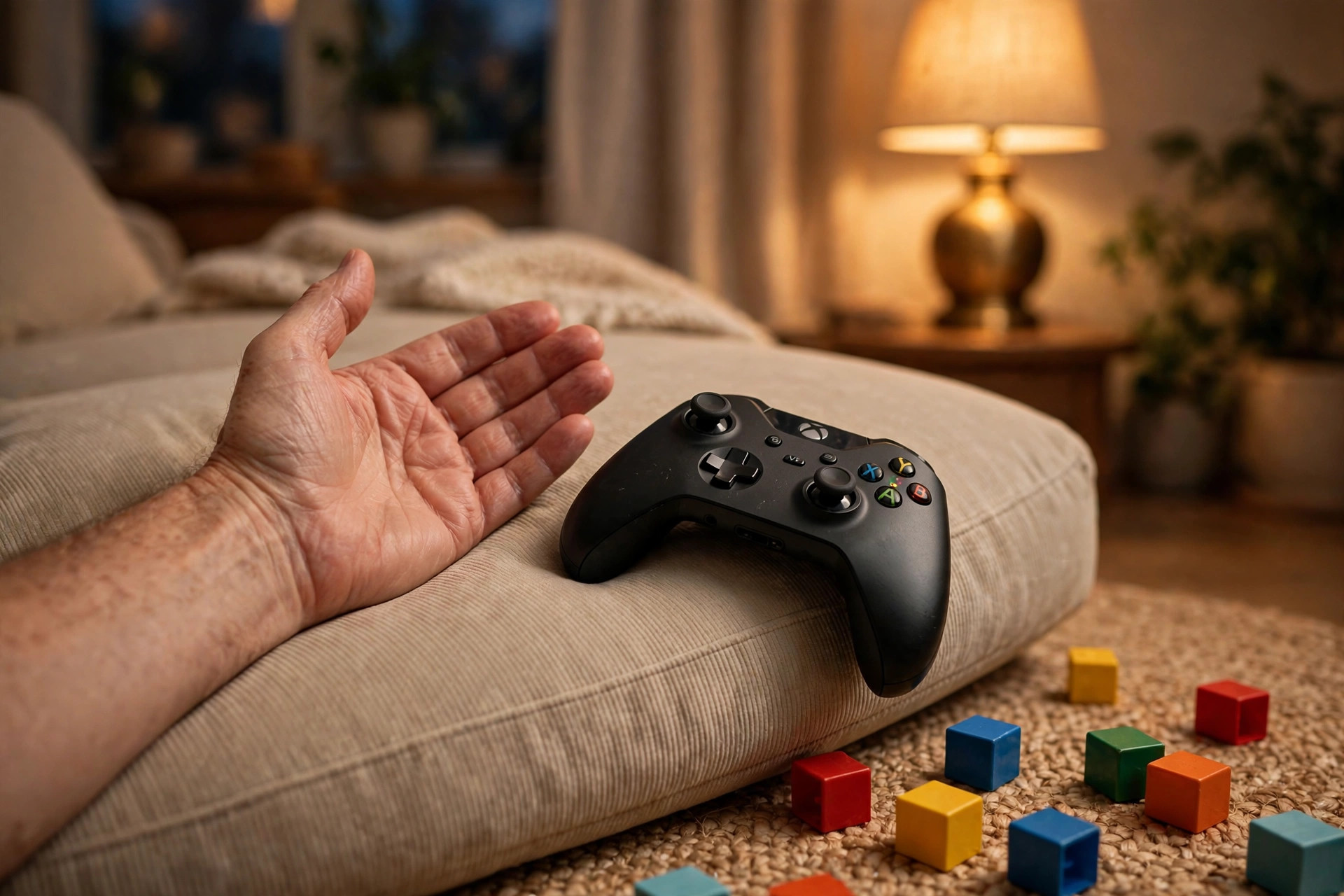
Sometimes the calm-down tool is just a hand to hold.
Here's what I actually like about it. It means I can still calm him. When he's coming apart — really coming apart, the kind of freak-out where words are useless and every sound in the house is too much — I know the move. Hand. Just a hand. He finds it, he works it, and the storm passes a little faster than it would have otherwise.
That's not nothing. On some days, that's the whole job.
And here's the part that catches me off guard every single time: how good he is at the things he actually cares about. He picked up LEGO Star Wars in about a week. A week. Then he talked me into playing two-player with him, and the little shit got me trapped in a corner and killed me over and over and over again, laughing in my face the whole time.
He might not be able to say everything he wants to say yet. But put a controller in his hands and watch what happens. He learns the game, he learns the trick, and then he uses the trick on you — on purpose, with a plan, and he's laughing because he knows exactly what he's doing.
That's the thing people get wrong about kids like mine. They see the hand thing and they see a kid who struggles. What they don't see is the kid who figured out a whole game in a week and then figured out how to beat his dad at it. The speech is still catching up. The brain was never behind.
So if your kid stims — let them stim. It's not a problem to fix. It's a nervous system doing its own regulation, for free, with whatever's in reach. And if they grab your hand while they're doing it, don't pull away. That's them telling you you're the safe place. That's them telling you that you can still reach them.
He might not be able to speak the best. But he can definitely do what he wants to do really well. And honestly? That's more than most of us can say.
— Bradley Creek